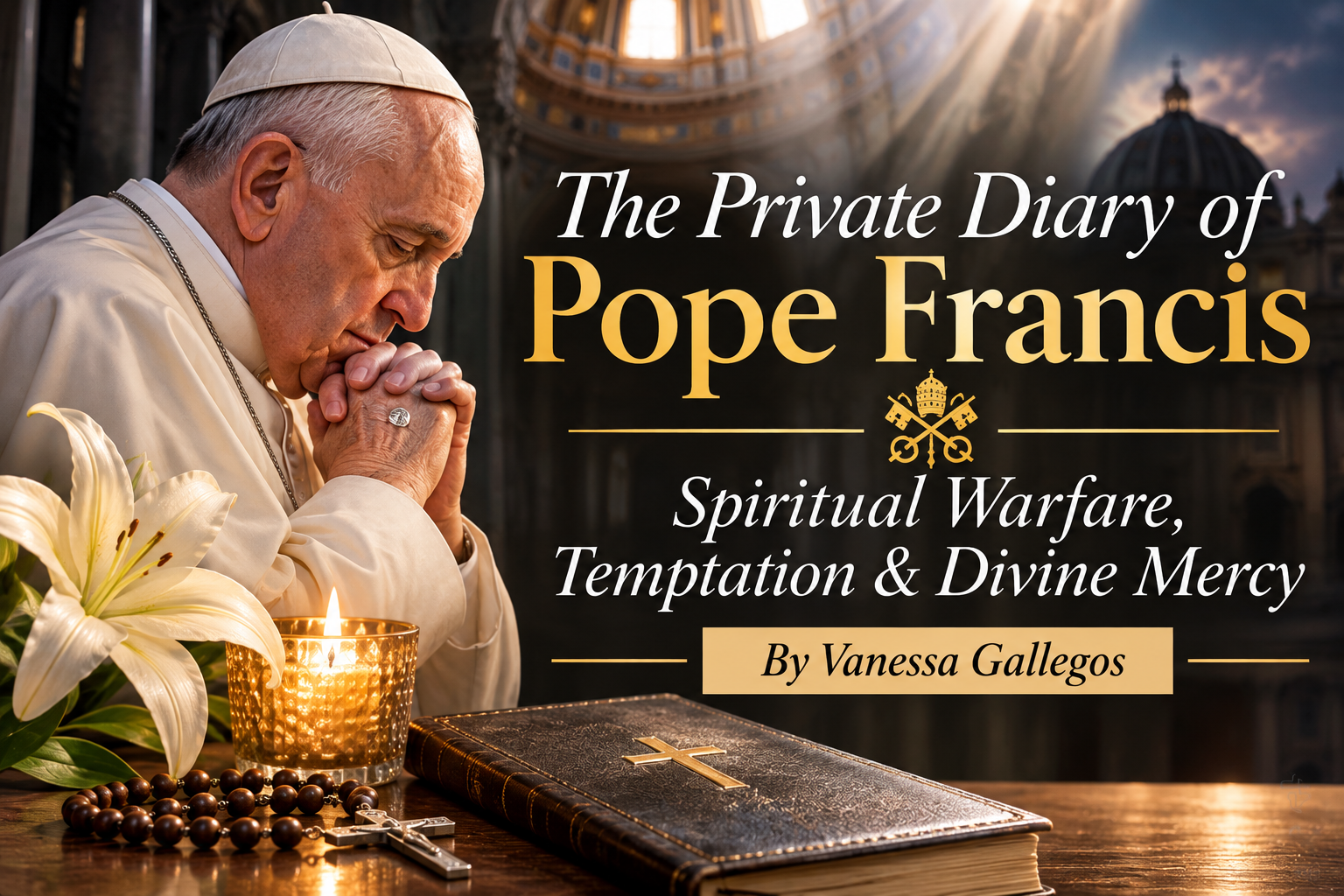

Pope Francis’ Private Diary: Encounters with the Devil, Visions of Hell, and the Power of God’s Mercy
By Vanessa Gallegos | Catholic Blogger | Palm Beach, Florida
November 24, 2026
What happens when the man entrusted with shepherding the Catholic Church finds himself confronting spiritual darkness, temptation, and profound interior suffering?
The publication of The Private Diary of Pope Francis offers a remarkable opportunity to reflect on the hidden spiritual life of the late Holy Father. Curated by Cardinal Víctor Manuel Fernández, the book presents selected personal writings of Jorge Mario Bergoglio spanning more than three decades, from 1992 to 2024.
Among the most striking revelations are his reported encounters with the devil, a disturbing vision of the entrance to hell, experiences of spiritual desolation, and his dependence on prayer and divine mercy.
As a Catholic, I find these revelations both unsettling and deeply meaningful. Not because they invite us to become fascinated with darkness, but because they remind us of the spiritual reality of our existence and our dependence on God.
Perhaps the most powerful lesson emerging from these writings is that no earthly position, religious title, or spiritual responsibility makes a person immune to temptation.
The Humanity Behind the Papacy
We often look at religious leaders through the lens of their public responsibilities. We see them celebrating Mass, delivering homilies, offering blessings, and guiding the faithful.
Rarely do we encounter the private spiritual battles that may accompany such responsibilities.
The newly published diary excerpts reveal a more vulnerable dimension of Pope Francis. His writings describe struggles with temptation, personal shortcomings, spiritual uncertainty, and the weight of ecclesiastical responsibility.
There is something profoundly human about this.
The Catholic faith has never taught that the pope is personally incapable of sin. Papal infallibility, which applies under specific conditions to definitive teachings on faith and morals, should not be confused with personal perfection or freedom from temptation.
Even the successor of Saint Peter remains a human being in need of God's grace.
Saint Peter himself denied Christ three times before becoming one of the foundational figures of the Church. His story reminds us that holiness is not necessarily the absence of weakness but the willingness to return to God after encountering it.
Pope Francis and His Reported Encounters with the Devil
One of the most discussed aspects of the diary is Pope Francis' description of experiences he understood as encounters with the devil.
In his interview with Vatican News, Cardinal Fernández explained that Francis recorded several such experiences, interpreting them within the context of his spiritual journey and his need for continued vigilance.
These accounts may surprise some readers, particularly in a modern culture that frequently dismisses the concept of spiritual warfare.
However, the existence of Satan and the reality of temptation are not new concepts within Catholic theology.
The Catechism of the Catholic Church, particularly paragraphs 391–395, explains the reality of fallen angels and the limits of Satan's power.
Although evil exists, it is not equal to God. Satan remains a created being, and his power is neither infinite nor capable of overcoming God's ultimate authority.
Saint Paul reminds us in Ephesians 6:12 that our spiritual struggle extends beyond the material realities of this world.
Nevertheless, discernment is essential. Pope Francis' descriptions of his personal experiences should not automatically be interpreted as independently verified supernatural events or new teachings of the Catholic Church.
The spiritual significance of these writings does not depend upon our ability to establish the precise nature of every experience he recorded.
What matters is how we respond to temptation, darkness, and the invitation to remain faithful to Christ.
The Vision of Hell: Confronting the Reality of Evil
One of the most disturbing passages discussed in the newly released excerpts concerns an entry dated June 7, 2018, in which Pope Francis wrote:
“Last night I saw the entrance to Hell.”
The context surrounding this entry is particularly important.
The writings emerged during the period in which Francis was confronting the gravity of the clergy sexual abuse scandal in Chile.
He had initially failed to recognize the credibility and seriousness of victims' accounts. Subsequent investigation led him to acknowledge his errors and apologize.
His spiritual anguish must be understood alongside the immense suffering experienced by survivors of abuse.
As Catholics, we cannot reflect on spiritual evil while ignoring the very real harm caused by human actions, institutional failures, and abuses of authority.
Prayer must never become a substitute for accountability.
Repentance must be accompanied by meaningful action, justice, transparency, and protection of the vulnerable.
The diary's imagery of hell invites us to reflect not only on the consequences of rejecting God but also on what happens when human beings abandon truth, compassion, and moral responsibility.
According to paragraph 1033 of the Catechism, hell is the state of definitive separation from God through one's own free choice.
This teaching challenges us to examine our own lives.
Are we moving closer to God through our decisions, relationships, and actions? Or are we allowing pride, selfishness, resentment, and indifference to distance us from Him?
The Subtle Nature of Temptation
When people hear the phrase spiritual warfare, they often imagine dramatic supernatural encounters.
Yet one of the most important revelations from Pope Francis' diary concerns something far more familiar: the temptation of power.
Cardinal Fernández connects Francis' spiritual crisis of 2021–2022 with his struggle against the desire for excessive control and the temptation to believe that he could resolve everything through his own authority.
This is perhaps one of the most relevant reflections for ordinary Catholics.
Temptation does not always present itself as something obviously destructive. Sometimes it disguises itself as a desire to succeed, to control circumstances, to prove ourselves, or to impose our own judgment upon others.
Pride can convince us that we no longer need correction.
Fear can persuade us that we must control every outcome.
Ambition can lead us to forget the importance of humility.
Even actions that begin with good intentions can become spiritually disordered when we lose sight of God.
The Gospel account of Jesus' temptation in the desert, found in Matthew 4:1–11, illustrates how power, recognition, and worldly authority can become instruments of temptation.
Christ responds not by seeking greater control but through obedience to the Father.
His example invites us to consider whether our own desire for control sometimes prevents us from trusting God's will.
The Power of the Holy Rosary
Another meaningful detail emerging from Pope Francis' writings is his reliance on the Holy Rosary during moments of spiritual distress.
For Catholics, the Rosary is more than a traditional devotion. It is a contemplative prayer that invites us to meditate on the life, death, and resurrection of Jesus Christ in the company of His Blessed Mother.
Through Mary, we are continually directed toward Christ.
Her words at the Wedding at Cana remain a beautiful expression of this relationship:
“Do whatever he tells you.” — John 2:5
The Rosary reminds us that we do not confront spiritual difficulties through our own strength alone.
Through prayer, we acknowledge our dependence on God and seek the intercession of the Blessed Virgin Mary.
However, the Rosary should not be understood as a magical object or a guarantee against suffering. Its spiritual value lies in the prayer, contemplation, faith, and trust it encourages.
In moments of fear, uncertainty, temptation, or sadness, returning to this devotion can help orient our hearts toward Christ.
Spiritual Desolation and the Ignatian Tradition
Pope Francis' background as a Jesuit provides an important framework for understanding his spiritual struggles.
Saint Ignatius of Loyola, founder of the Society of Jesus, developed teachings on the discernment of spirits that help believers recognize interior movements toward or away from God.
Ignatian spirituality distinguishes between spiritual consolation and spiritual desolation.
Consolation draws us toward greater faith, hope, and love. Desolation can involve spiritual discouragement, interior confusion, or a diminished sense of God's presence.
One of the greatest challenges of faith is learning to remain faithful even when we do not experience emotional or spiritual comfort.
There may be seasons when prayer feels difficult, when answers seem distant, and when we struggle to understand what God is asking of us.
The absence of spiritual consolation does not necessarily mean that God has abandoned us.
Nor should every experience of emotional distress be attributed to demonic activity. Discernment requires humility, prudence, and an understanding of both spiritual and human needs.
The published reflections on Francis' interior crisis offer an opportunity to consider what perseverance looks like when faith is tested.
Faith is not simply believing when everything feels peaceful. It is also continuing to seek God when the path ahead is unclear.
Divine Mercy: The Most Important Message of the Diary
Although the reported encounters with the devil and visions of hell will undoubtedly attract considerable attention, I believe the most important spiritual message of these writings concerns God's mercy.
According to Cardinal Fernández, Francis emerged from his period of spiritual crisis through a renewed surrender to God.
This is consistent with one of the central themes of his pontificate: the invitation to trust in divine love rather than become consumed by our own shortcomings.
His 2023 apostolic exhortation, C'est la confiance, reflects on the spirituality of Saint Thérèse of Lisieux and the importance of confidence in God's merciful love.
His 2024 encyclical, Dilexit Nos, explores the human and divine love of the Sacred Heart of Jesus Christ.
Reading about these spiritual struggles alongside his later writings gives us another way to appreciate the significance of his teachings on mercy and trust.
Christianity is not ultimately a story about the triumph of darkness.
It is the proclamation of Christ's victory over sin and death.
The Cross reminds us that suffering and evil do not have the final word. The Resurrection reminds us that even the deepest darkness cannot extinguish the light of God.
What Can Catholics Learn from Pope Francis' Private Diary?
As I reflect on the newly published excerpts, several lessons stand out:
First, spiritual vigilance is necessary for everyone. No person is beyond the need for prayer, humility, and examination of conscience.
Second, authority does not eliminate human weakness. Religious responsibility must be accompanied by accountability and a willingness to recognize mistakes.
Third, evil should be taken seriously without becoming an obsession. Our spiritual attention should remain centered on Christ rather than on fear of the devil.
Fourth, prayer and the sacraments remain fundamental. The Holy Eucharist, Reconciliation, Scripture, and Marian devotion help nourish our relationship with God.
Finally, God's mercy is greater than our failures. The Christian response to weakness is not despair but repentance, conversion, and renewed trust.
A Reflection as We Approach Advent
The timing of this publication is particularly meaningful as we prepare to enter the Advent season.
Advent invites us to remain spiritually awake, examine our hearts, and prepare for the coming of Jesus Christ.
The private struggles described by Pope Francis remind us that this preparation is not merely external. It requires interior conversion.
Perhaps, instead of asking what Pope Francis saw in his reported vision of hell, we should also ask what areas of darkness exist within our own hearts.
Where have we allowed pride to replace humility?
Where have we chosen control over surrender?
Where have we failed to recognize the suffering of others?
Where have we forgotten to trust in God's mercy?
These questions may be uncomfortable, but they can also become invitations to spiritual growth.
Final Reflection: Do Not Lose Sight of Christ
The publication of Pope Francis' private diary offers an opportunity to look beyond the public image of the papacy and reflect on the complexity of the spiritual life.
What strikes me most is not that a pope experienced temptation or spiritual darkness. It is that his writings point toward the continued necessity of returning to God.
We should approach these accounts neither with sensationalism nor with fear, but with discernment, compassion, and spiritual maturity.
Our Catholic faith teaches us that evil is real, but it also teaches us that God's love is infinitely greater.
Ultimately, the purpose of understanding spiritual warfare is not to become fascinated with the devil.
It is to become more deeply committed to Christ.
May these reflections encourage us to pray more intentionally, examine our consciences with humility, seek God's mercy, and approach the upcoming Advent season with renewed faith and hope.
With faith,
Vanessa Gallegos
Faith & Frame | Palm Beach, Florida
Author's note: This reflection is based on the publicly available excerpts of The Private Diary of Pope Francis and contemporary reporting surrounding its publication on November 24, 2026. It is a Catholic spiritual and theological commentary rather than a comprehensive review of the complete book.
Vanessa Gallegos is a Catholic blogger based in South Florida. Through Faith & Frame, she shares reflections on Catholic spirituality, religious literature, Scripture, Church teachings, and contemporary matters of faith, offering a perspective rooted in prayer, discernment, and spiritual growth.